
What condensing means
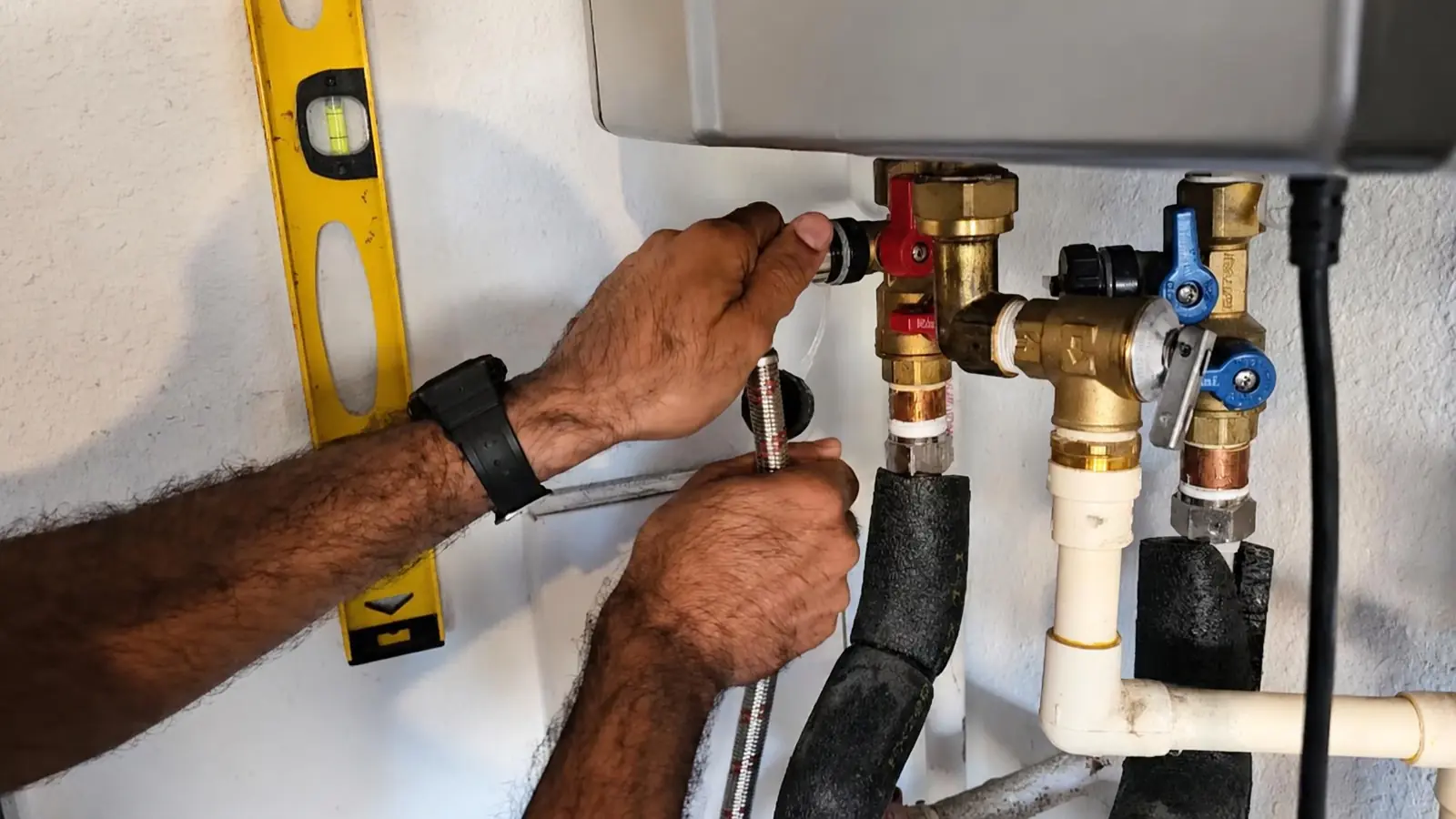
A standard gas tankless unit sends hot exhaust up a metal flue. A condensing unit has a second heat exchanger that pulls heat from the exhaust until the water vapor in it turns to liquid. The exhaust that leaves is cool enough for plastic venting, and the liquid has to go somewhere.
That liquid is condensate. It is mildly acidic, so it is drained through a neutralizer in many installations before it reaches a drain. Whether a neutralizer is required depends on the manufacturer and local rules, so confirm before the install day.
What the house has to supply
Pre-install checklist
- A gas line sized for the unit's full burner input.
- A vent path to the outside that meets the manual.
- Combustion air, either from inside or piped from outside.
- A drain for condensate and a neutralizer if specified.
- A nearby electrical outlet for the controls.
- Wall space and service clearance.
- Service valves on the water lines.
The gas line is the most common surprise. A tankless unit demands a large amount of gas at once, far more than a tank burner. If the existing line is sized for a tank, a stove and a dryer, it may not carry the load. Upsizing it is a separate piece of work.
Venting is the second. Condensing units use plastic pipe that must slope back toward the unit so condensate drains instead of pooling. The manual limits the length and the number of elbows, and a long run through a finished wall is a real cost.
Comparing the options
| Factor | Tank | Standard tankless | Condensing tankless |
|---|---|---|---|
| Venting | Metal flue | Stainless metal | Plastic, sloped. |
| Condensate drain | No | Usually no | Yes. |
| Gas line | Smaller | Large | Large. |
| Efficiency | Lowest | Higher | Highest of the three. |
| Upfront scope | Smallest | Larger | Larger, plus drain work. |
Hard water and maintenance
Tankless heat exchangers are narrow, and scale gets in the way of heat transfer. A condensing unit has two exchangers to keep clean. Plan on a descaling flush every year in hard water, and have isolation valves installed so the flush is simple.
The condensate neutralizer also needs attention. The media inside it wears out and has to be checked on a schedule the manufacturer sets. A neglected neutralizer sends acidic water to the drain.
Seismic and code points
California Health and Safety Code section 19211 addresses bracing of water heaters in earthquake zones, and wall-hung tankless units are secured to the wall by their own mounting. Whatever the type, the installation has to follow the manufacturer's instructions and local code, and gas work should only be done by a qualified plumber.
Sizing and household demand
Tankless units are rated by flow in gallons per minute at a given temperature rise. The incoming water in Southern California is mild for much of the year, so the temperature rise needed is smaller than in a cold climate, but the flow you need still depends on how many fixtures run at once.
Count the showers, the dishwasher and the washing machine that might run together in a busy morning. A single unit sized for two showers will struggle with three. Households with several bathrooms sometimes use two units, or choose a larger single unit, and the choice changes the gas and venting plan.
Ask the installer to size from your real use, not from a rule of thumb. A unit that is too small gives lukewarm water when fixtures overlap, and one that is too large costs more up front for capacity you do not use.
What this means for Lynwood homes
Census estimates put about 47 percent of Lynwood housing before 1950. Gas lines in those homes were sized for older appliances, so the gas capacity check matters before you choose a tankless unit. Ask for the line to be measured, not assumed.
Liberty Utilities' Lynwood system report lists hardness from 99 to 220 ppm, averaging 160 ppm, about 9 grains per gallon. South Gate's 2021 city report averaged 226 ppm. For a tankless heater that is a reason to flush yearly or add a water softener.
SoCalGas customers who smell gas should leave the area and call SoCalGas at 1-800-427-2200 from a safe place. The City of Lynwood adopts the California Plumbing Code in Chapter 11-9, so ask its community development department what permit your gas work needs.
Call to book a visit. We will measure the gas line and the vent path and tell you what the job takes.
If your goal is simply to replace a failing tank, water heater replacement is usually the lower-cost path. Homeowners in South Gate can see local details on our South Gate page.
Questions homeowners ask about this
It has a second heat exchanger that pulls extra heat from the exhaust, which cools the exhaust enough for plastic venting and produces condensate.
Yes. The condensate has to drain, often through a neutralizer. Your installer confirms the requirement for the model.
Not always. Tankless units draw a lot of gas at once, so the line must be sized for the full load.
Usually not. Condensing units use their own plastic venting, sloped back toward the unit.
In hard water, once a year is a sound starting point.
Many were built long before tankless units existed, and their lines were sized for smaller loads. A measurement tells you whether upsizing is needed.