
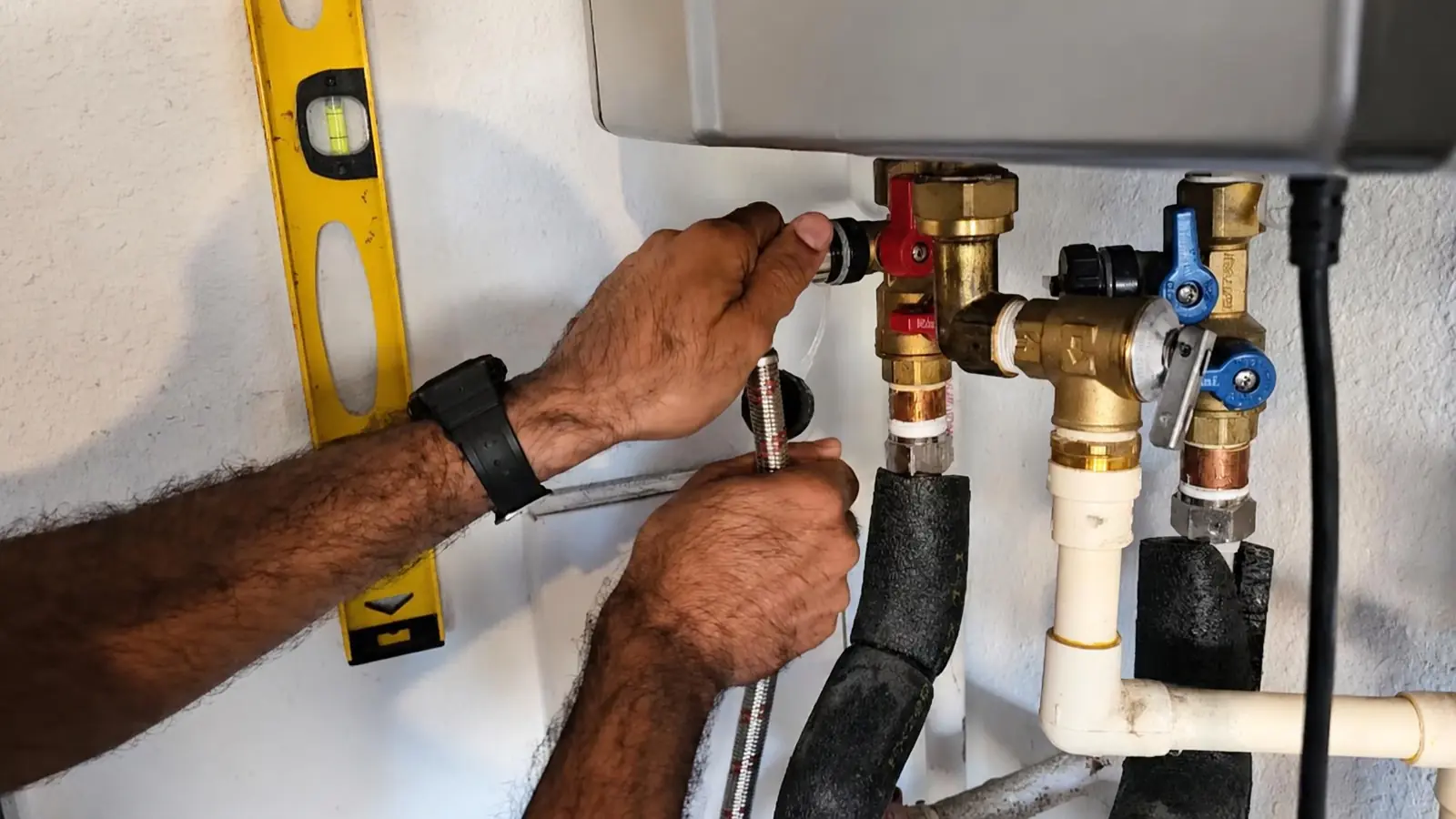
What a tankless unit needs from the house
A gas tankless heater draws far more gas at once than a tank does, so the gas line has to be sized for it. It also needs a dedicated vent, usually stainless or special plastic, run to the outside. Electric tankless units need a heavy circuit, and some homes need a panel upgrade.
That is why a tankless install is a bigger decision than a tank swap. We check gas capacity, venting path and clearance before we quote, so the price reflects what the house requires.
Hard water, scale and flushing
Liberty Utilities' Lynwood system reported hardness from 99 to 220 ppm, averaging 160 ppm, about 9 grains per gallon. South Gate's city water averaged 226 ppm in its 2021 report. Tankless heaters have a narrow heat exchanger, and scale builds up there first.
Scale shows as fluctuating temperatures, error codes and reduced flow. A flush circulates a descaling solution through the heat exchanger and removes the buildup. In this area we suggest a flush every year, or more often if you see symptoms. A water softener reduces how fast scale builds.
Signs a tankless heater needs flushing or service
- Hot water that turns lukewarm or fluctuates.
- An error code on the display.
- Low flow at the hot tap.
- Noise like a kettle starting to boil.
- A unit that has not been flushed in over a year.
- Water that takes longer to arrive.
How we flush and descale
We close the isolation valves, connect a pump and hoses to the service ports, and circulate descaling solution for the time the maker specifies. Then we flush with clean water, clean the inlet filter and reopen the valves. We record the readings before and after so you can see what changed.
Isolation valves are the key. Units installed without service valves cost more to flush, because they must be added first. We recommend adding them during any visit where they are missing.
Tankless repair
Common repairs include replacing a flow sensor, cleaning a scaled heat exchanger, resetting an error that traces to a venting problem and replacing a control board. Each unit's display codes point to the fault, but we confirm with measurements before replacing a part.
| Factor | Tank | Tankless |
|---|---|---|
| Space | Needs floor space for the tank | Wall-mounted and compact. |
| Hot water supply | Limited by tank size | Continuous, limited by flow rate. |
| Install complexity | Simpler, like-for-like | Gas line and venting often need work. |
| Maintenance | Flush and anode check | Annual flush, critical in hard water. |
| Multiple showers | Depends on tank capacity | Depends on unit's flow rating. |
Large households sometimes pair two units to cover several bathrooms at once, and we will tell you if your layout calls for that. For a failed tank, our replacement page covers the options.
Call to schedule. If the unit has stopped working, our 24/7 line can dispatch a plumber.
What affects the price of tankless service
We give a clear price before work starts. Here is what shapes it.
Maintenance and wear are not usually covered by home insurance. Check any manufacturer warranty, because some require documented flushing. Want your real number? Call (213) 672-5590.
Customers just across the line in South Gate, ZIP 90280, are covered through our South Gate page.
Common questions about tankless water heaters
In hard water areas like this, once a year is a sound starting point. Heavy scale or error codes may mean sooner.
A scaled heat exchanger, a failed flow sensor or a venting problem can all cause it. A flush and a diagnostic check find the cause.
Often, but the gas line may need to be upsized because the unit draws a lot of gas at once. We check before quoting.
Some can, depending on venting and clearance. We look at the space and the exhaust path.
We work on common tankless brands. Tell us the make and model and we will confirm.
Call our 24/7 line. If it is a no-hot-water fault, we dispatch for diagnosis.