What the local water reports say
Liberty Utilities' Lynwood system report for 2023 lists total hardness between 99 and 220 ppm, averaging 160 ppm. The report also gives grains per gallon, with an average near 9.4. By common water-quality scales, that range runs from moderately hard to very hard.
The City of South Gate's 2021 report listed an average of 226 mg/L, ranging from 200 to 250. Converted at 17.1 mg/L per grain, that is about 13 grains per gallon. The reports speak to the utility's system overall. Your tap can differ, so test it.
Utility reports describe the water as delivered, not what is in your house plumbing. Ask your provider for its current water quality report, and use a home test kit or a lab test to see what comes out of your tap.
What hard water does at home
Signs of hard water
- White crust on faucets and showerheads.
- Spotted dishes and glassware.
- Soap that does not lather well.
- Shortened life of water heaters and appliances.
- Dry skin or stiff laundry.
- Low flow caused by scale in aerators.
Scale insulates heating elements and coats the inside of pipes, so the water heater burns more fuel to reach the same temperature. That is why many homeowners in hard water areas start with a softener after a heater failure. Our tankless page explains why the narrow heat exchanger is especially sensitive.
Softener, filter or both
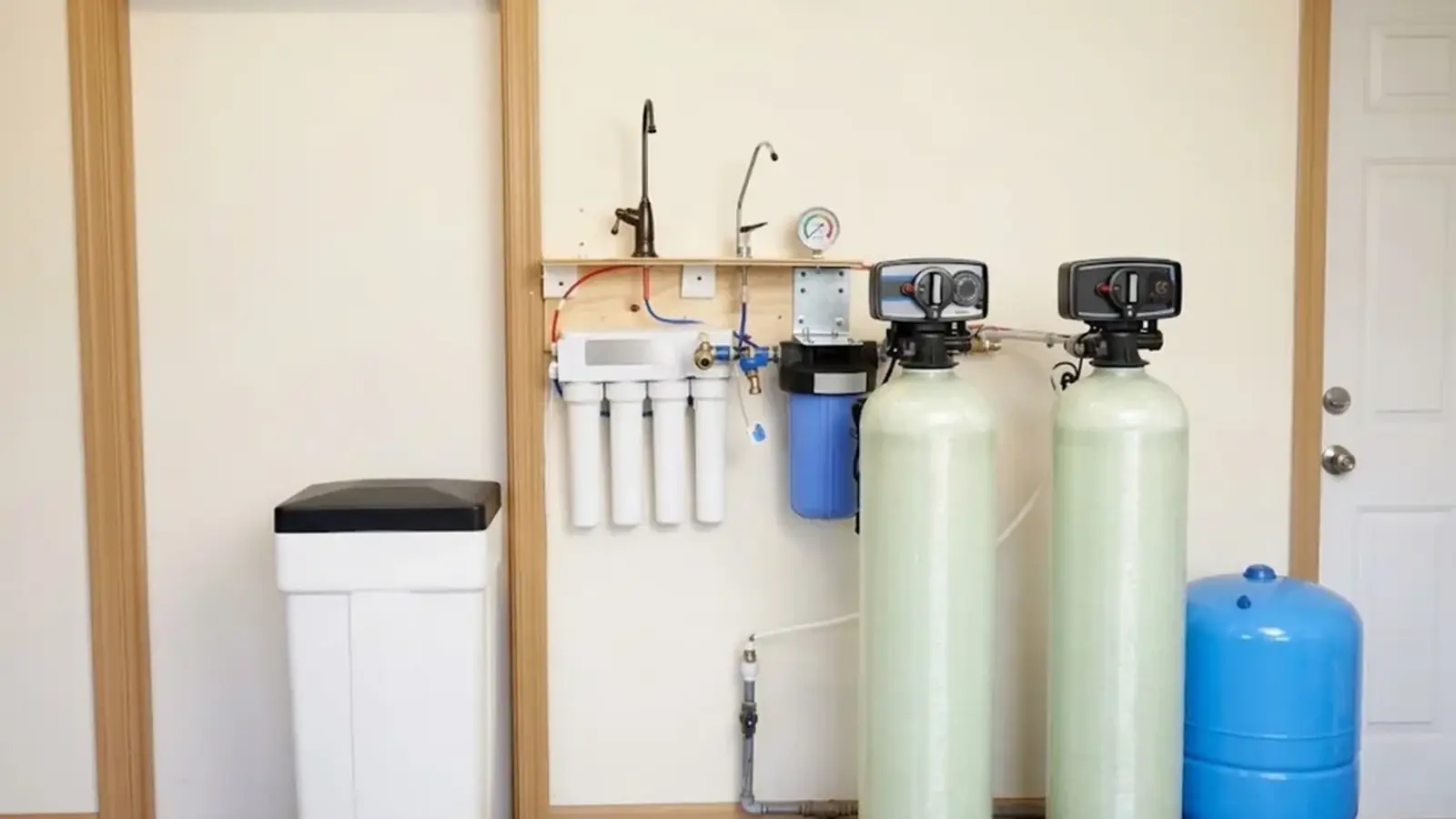
A softener removes hardness minerals and does not filter chlorine, taste or odor on its own. A whole-house carbon filter handles taste and chlorine. Reverse osmosis at the kitchen sink polishes drinking water. Many homes combine a softener with a point-of-use filter.
| Option | What it addresses | Where it goes |
|---|---|---|
| Salt-based softener | Hardness scale | At the main water line, before the heater. |
| Whole-house carbon filter | Chlorine, taste and odor | At the main water line. |
| Reverse osmosis | Drinking and cooking water quality | Under the kitchen sink. |
| Scale inhibitor | Reduces scale without removing minerals | At the main water line, where appropriate. |
What goes into an installation
The softener tees into the main line after the hose bibs you do not want softened, with a bypass valve so the water can be turned off to the unit. The control valve needs a drain path for regeneration water, an air gap and a power outlet. Salt-free options skip the drain, but they work differently.
Location matters. A garage or side yard with enough clearance and a nearby drain suits most homes. We check that the unit will sit level, the drain is protected by an air gap and the brine tank can be reached for refills.
Call to schedule a visit. We will recommend a system after we see where it will go.
What affects the price of a softener installation
We give a clear price before work starts. These items decide it.
Water treatment equipment is not usually covered by home insurance, and manufacturer warranties vary. Want your real number? Call (213) 672-5590.
We also serve South Gate, where the city's own water system is separate from Liberty's, and our South Gate page covers that side. If you are unsure whether scale is hurting your heater, water heater installation explains what a protected setup looks like.
Common questions about water softener installation
Liberty Utilities' 2023 report for its Lynwood system lists hardness from 99 to 220 ppm, averaging about 160 ppm. That is moderately hard to hard. Test your own tap, because home plumbing and your provider can differ.
Properly set up softeners add a very small amount of sodium. Many people notice no taste change. Drinking water can still be filtered with RO.
No. It addresses hardness minerals. A carbon filter handles chlorine and taste.
To a nearby floor drain, laundry standpipe or utility sink, through an air gap. We confirm a suitable drain before installing.
Typically every one to two months for a salt-based system, depending on household size and water hardness.
Some homeowners do. The plumbing, bypass and drain need to be done correctly. We can install it or check your work.