
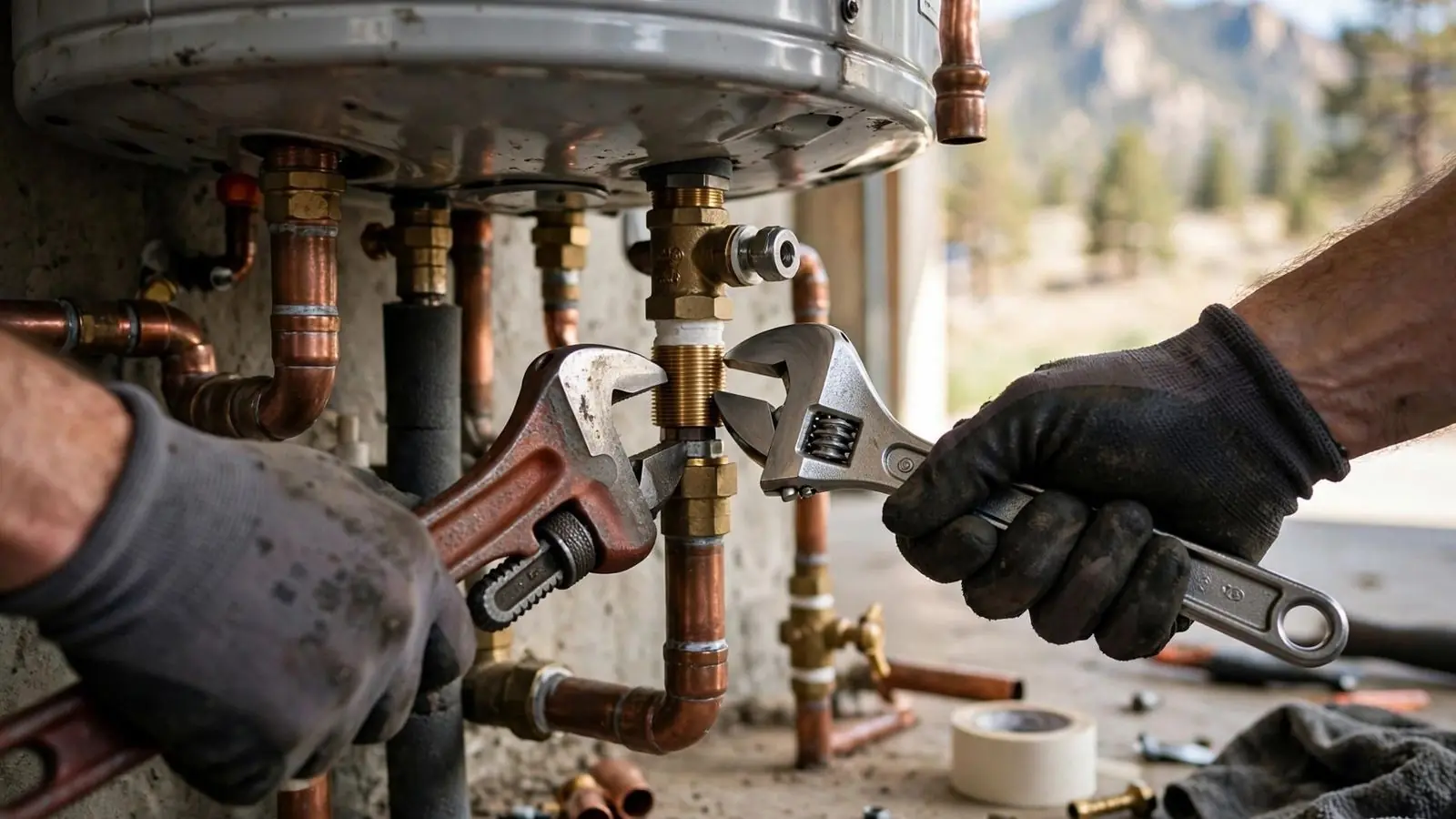
What a water heater installation includes
A complete installation covers the unit, a new relief valve and discharge pipe, and a sediment trap and shutoff on gas models. It also includes seismic strapping, an expansion tank where the system needs one and a test of the finished work. Venting is checked on gas units, and electrical connections are verified on electric ones.
We also review where the unit will sit. A garage location needs a platform for gas units in many cases, and a closet needs enough clearance for service. Placement affects both safety and future repairs.
Safety checklist before install day
- Clear the area around the old heater so the crew has room.
- Know where your gas shutoff and main water valve are.
- Keep children and pets away from the work area.
- Do not store paint, gasoline or cleaners near the new unit.
- Confirm you have a working carbon monoxide alarm on gas homes.
- Plan for hot water to be off for part of the day.
California rules that shape the job
California Health and Safety Code section 19211 requires water heaters to be braced, anchored or strapped against earthquake motion. The California Plumbing Code treats expansion tanks in section 608.3 for closed water systems, where heated water has no place to expand.
Lynwood's municipal code adopts the California Plumbing Code in Chapter 11-9, with permit fees paid to the community development department. Scope and permit rules vary, so ask the city before work starts. We can walk through what your install involves when we quote it.
Choosing the type
| Type | What changes | What to confirm first |
|---|---|---|
| Gas tank | New flue connection and gas line fittings | Vent condition and gas line capacity. |
| Electric tank | New wiring connection and breaker check | Panel capacity and breaker size. |
| Heat pump | Space, condensate drain and a dedicated circuit | Clearance and an adequate electrical supply. |
| Tankless | Gas line sizing and special venting | Gas capacity and exhaust path. |
Heat pump units pull heat from the air and use less electricity than a standard electric tank. They need room around them and a place to drain condensate. We cover that decision in more depth on our tankless page for the alternative option, since both change how the system is laid out.
Older Lynwood homes and where the heater goes
Census estimates show about 47 percent of Lynwood housing dates before 1950. Water heaters in those homes are often in a hall closet, an attached garage or a small utility room that predates current clearances. A new unit may need a different vent run or a platform, and we plan for that before the install day.
For homes built in the 1950s and 1960s, about a third of the stock, the water heater is more often in a garage or an exterior closet. Those locations can be exposed to heat and dust, which affects burner life on gas units.
Questions we ask before an install
- Gas or electric today, and do you want to switch?
- How many people use hot water, and when?
- Where does the unit sit and what is the clearance around it?
- Does the current unit have an expansion tank?
- Is there a visible vent, and what condition is it in?
- Do you want to plan for hard water protection?
Hard water and the new heater
The Liberty Utilities report for its Lynwood system lists hardness of 99 to 220 ppm, averaging 160 ppm. South Gate's city report averaged 226 ppm. Scale builds inside the tank and on elements, so a yearly flush and an anode rod check keep the new unit working longer. A softener can add protection.
Call to book. We will confirm the unit, the fuel and access before the visit.
What affects the price of a water heater installation
You get a clear price before work starts. These are the items that move it.
Planned installs are not usually an insurance event. If you are replacing a failed unit, ask your insurer about related water damage. Want your real number? Call (213) 672-5590.
Homes in the 90280 ZIP code near the I-710 are covered the same way, and our South Gate page explains the area. If your old heater is already failing, water heater repair may buy time for a planned install.
Common questions about water heater installation
A like-for-like tank install is often finished in a few hours. Fuel changes, new venting or electrical work can take longer.
Closed water systems usually need one to absorb thermal expansion. We check your system and recommend whether it is needed. The California Plumbing Code covers expansion tanks in section 608.3.
Yes. California Health and Safety Code section 19211 requires it, and we include seismic strapping.
Often yes, but it changes piping, venting and sometimes electrical work. We quote that as a larger scope.
They can work well in the right space. Make sure there is room for airflow and a drain for condensate, and that your electrical panel can support the circuit.
Yes, with owner or manager approval. We coordinate access and shutoff timing so other units are not affected for long.