
Why one unit sometimes is not enough
A tankless heater is limited by its flow rate. If a shower, a dishwasher and a washing machine run together, the demand can exceed what the unit can heat. The result is water that turns lukewarm or fluctuates.
A bigger single unit may be enough. Many homes get by with one unit sized properly. A dual setup is for homes where the combined peak demand, or the distance between bathrooms, makes one unit impractical.
Two ways to set it up
| Layout | How it works | Best for |
|---|---|---|
| Linked units | Two heaters connected so they share the flow | One large demand point, many fixtures at once. |
| Zoned units | Each heater serves its own area | Long runs, separate wings or an ADU. |
| Main plus booster | A second unit near a distant bathroom | Long pipe runs with delay. |
Linked units can fire one or both as demand rises. This balances wear and covers peaks. Zoned units each carry a portion of the house, which shortens the wait for hot water at distant fixtures.
What two units require
Plan for each unit's needs
- Gas supply sized for the combined load of both units.
- Separate vent runs or a combined system the maker approves.
- Condensate drains if the units are condensing.
- Clearances and mounting space for both.
- Electrical outlets for the controls.
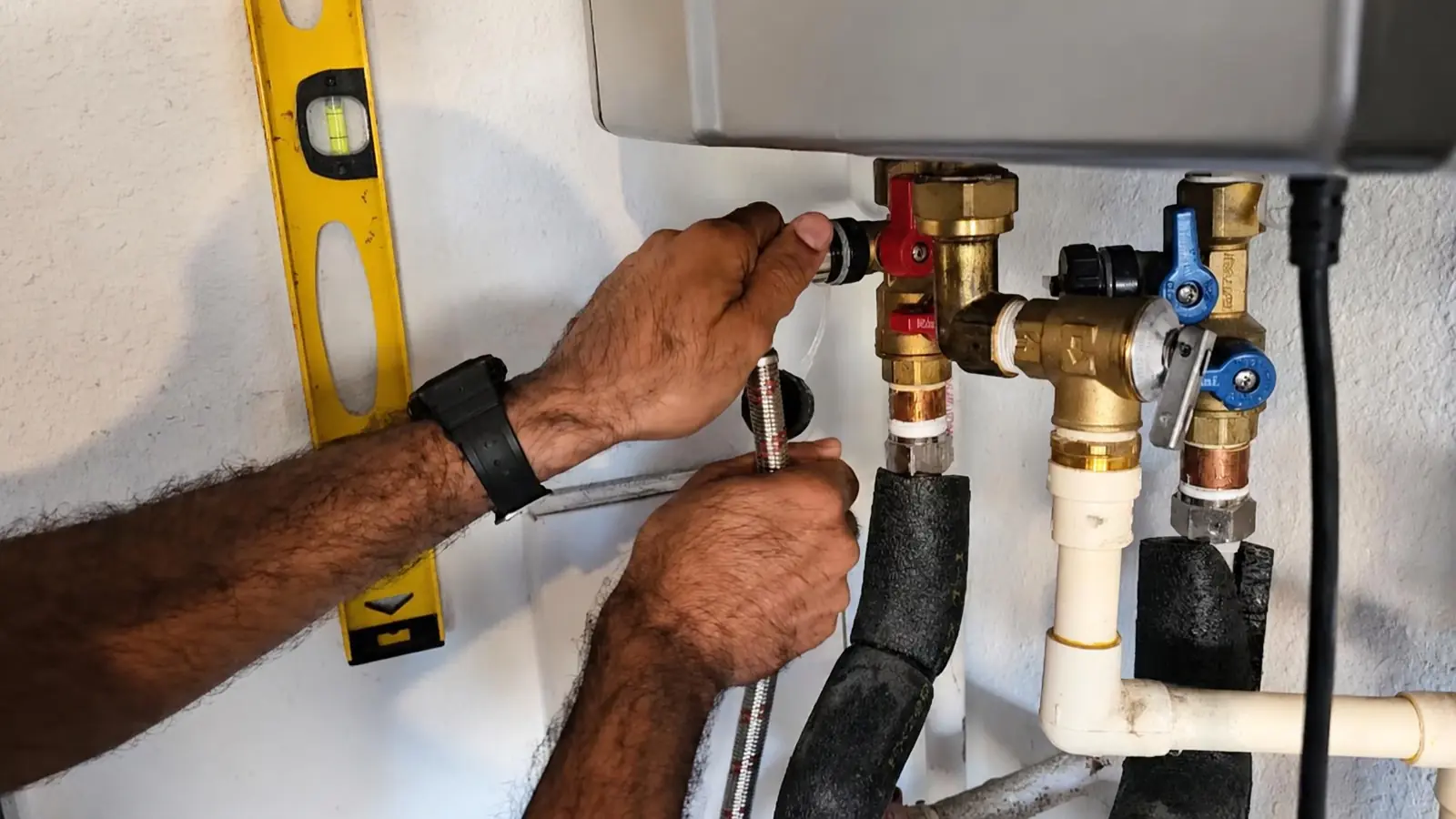
- Isolation valves on each unit for flushing.
- Space to service both without moving anything.
The gas line is the first limit. Two tankless units can demand a very large amount of gas at the same time. If the house meter, the line size or the regulator cannot supply it, the project changes. SoCalGas should be involved where the meter or service needs a change.
Safety checklist for gas tankless units
- Install a carbon monoxide alarm near sleeping areas.
- Keep the area around the unit and the vent clear.
- Never store flammable items near the heater.
- Know where the gas shutoff is and how to close it.
- Do not tamper with the vent or the condensate drain.
- Have the unit serviced on the maker's schedule.
Maintenance doubles too
Each unit needs its own flush. Each has its own filter, its own condensate neutralizer if it is a condensing model and its own failure points. That is not a reason to avoid a dual setup, but it is a reason to budget for upkeep and to choose isolation valves from the start.
Alternatives to consider
A single large tankless unit, a larger tank, a tank with a recirculation line or a small point-of-use unit at a distant bathroom can sometimes solve the same problem at lower cost. Which one fits depends on what is actually wrong. If the issue is the wait for hot water at a far bathroom, a recirculation pump may be simpler than a second heater.
Our water heater replacement work can lay out these options when your heater needs to be replaced anyway.
Sizing a dual setup properly
Sizing starts with a count. Add up the fixtures that can run together at your busiest time, estimate the flow of each and compare the total with the unit's rating at the temperature rise you need. A dishwasher and a washing machine draw less than a shower, but they add up.
If the total is close to one unit's limit, a second unit may be justified, or you may change habits slightly by staggering use. If the total is far above one unit's limit, a dual setup or a larger single unit becomes the practical choice.
Whatever you choose, ask the installer to put the sizing in writing and to show the manufacturer's chart. That protects you from an undersized system and from paying for capacity the household will never use.
A short decision guide
If your home has one or two bathrooms and a typical household, start with one properly sized unit. If it has several bathrooms, a distant wing or an accessory dwelling, price a dual or zoned setup. If your main complaint is a long wait for hot water, price a recirculation pump first.
What this means for Lynwood homes
Census estimates put about 47 percent of Lynwood housing before 1950, with a median build year near 1951. Many of those homes are modest in size and have one or two bathrooms, so a single properly sized unit is more common than a dual setup. A dual setup fits larger homes, additions and accessory dwellings.
Liberty Utilities' Lynwood system report lists hardness from 99 to 220 ppm, averaging 160 ppm. With two heat exchangers to protect, a water softener or a firm flush schedule matters even more.
SoCalGas customers who smell gas should leave the area and call SoCalGas at 1-800-427-2200 from a safe place. The City of Lynwood adopts the California Plumbing Code in Chapter 11-9, so ask its community development department what permits gas work needs.
Gas appliance installation follows the California Plumbing Code, which is based on the Uniform Plumbing Code (UPC), and the manufacturer's installation instructions.
Call and tell us about the household. We will size it and say plainly if one unit will do.
Homes in the 90280 ZIP code across the line are covered through our South Gate page.
Questions homeowners ask about this
When combined peak demand or long pipe runs exceed what one unit can handle. Many homes do fine with one properly sized unit.
Not usually two lines, but the line has to carry both units' combined load. That often means upsizing.
Yes. Each unit needs its own flush and service.
Sometimes, if the gas, venting and space were planned for it. Tell the installer if you might expand.
A recirculation pump or a small unit near the distant bathroom can help without a full dual setup.
Less so. About 47 percent of the housing predates 1950 and tends to be smaller. Larger homes and additions are the better fit.