
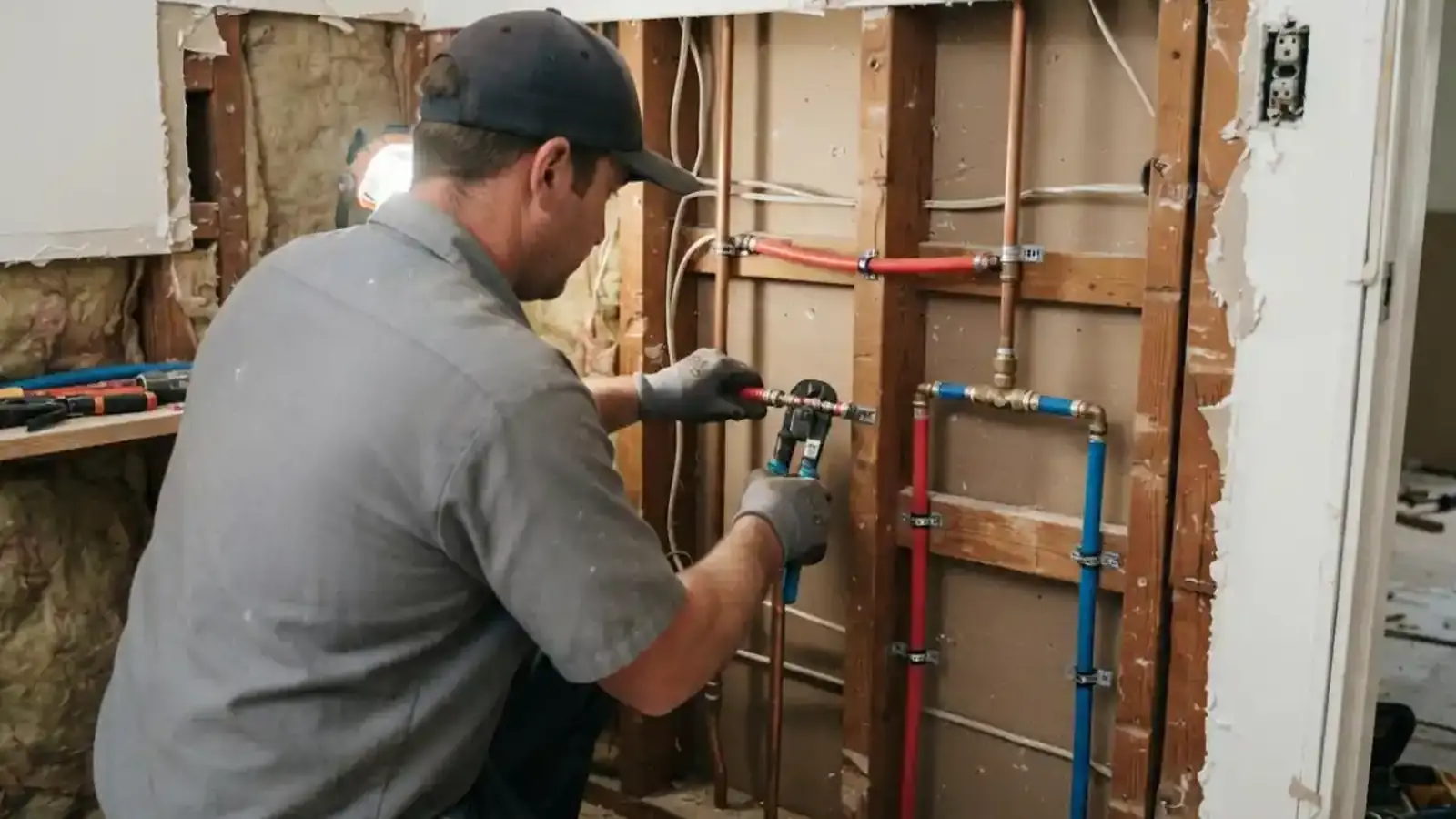
What PEX is
PEX stands for cross-linked polyethylene. It comes in coils and in colored lines for hot and cold. It bends around corners, so a plumber can run it through walls and attics with few fittings. Each fitting is a possible leak point, and fewer fittings means fewer chances for one.
PEX does not corrode and it handles a freeze better than rigid pipe. It cannot be exposed to sunlight, and it should not touch certain chemicals or sit near a flue. It is used inside the structure, not in open sun.
PEX compared with copper
| Factor | PEX | Copper |
|---|---|---|
| Material cost | Lower | Higher. |
| Install speed | Faster | Slower. |
| Wall openings | Fewer | More. |
| Corrosion | None | Can pit over time. |
| Sunlight | Must be covered | No issue. |
| Noise | Quieter, but can expand and tick | Can transmit noise. |
| Lifespan | Long, with correct fittings | Very long in the right water. |
Both are accepted choices and both work well when installed correctly. The better question is which one suits your house, your budget and your preference for how the work is done.
Signs a repipe makes sense
Signs your pipes may be failing
- Repeated pinhole leaks in different places.
- Brown or rusty water from the hot or cold tap.
- Falling water pressure through the house.
- Galvanized steel pipe still in the walls.
- Green or white crust on copper lines.
- Water stains on ceilings with no visible source.
A single leak does not mean a repipe. Several leaks in a short time suggests the system is wearing out. A leak detection visit can show whether you have one weak spot or a failing system, and that is worth knowing before you spend on either.
What the job involves
We shut off the water, map the new routes and open small access points in walls and ceilings. New lines go in, fixtures are reconnected and the system is pressure tested. Drywall patching is part of the scope, and the quote says who does the finish and paint.
Most homes are without water for part of each working day, not the entire time. Two-story homes and homes with slab foundations take longer, and a repipe can often be done in stages.
Partial or whole
A partial repipe replaces the worst section, for example a run of galvanized pipe that keeps leaking. A whole repipe replaces everything. Partial is cheaper now and may mean another repair later. Whole costs more now and ends the pattern. We say plainly which fits when we see the pipe.
Costs and what moves them
We give a clear price before work starts, so this section is about what moves the price, not a figure. The size of the house and the number of fixtures are the biggest drivers, followed by access. A slab home, a two-story layout or a hard-to-reach crawlspace each change the work.
Wall repair is the next big item. PEX needs fewer openings than copper, which can reduce drywall patching. Who does the patching and paint is a line in the quote, and homeowners often handle the finish themselves to control the cost.
Permit and inspection fees depend on the city and the scope. Ask for the whole picture up front, including what happens if the inspector finds something that has to be corrected, so the price you are quoted is the price you plan around.
Questions to ask any repiping contractor
Ask what pipe and fittings will be used, who pulls the permit and schedules the inspection, how walls will be patched and what the warranty covers. Ask also what happens if the crew finds damaged framing or old pipe in a place you did not expect.
What this means for Lynwood homes
Census estimates put about 47 percent of Lynwood housing before 1950 and about 35 percent in the 1950s and 1960s. Galvanized steel and early copper are common in those decades. Galvanized fails by narrowing from the inside, and copper from pinholes.
Liberty Utilities' Lynwood water quality report lists hardness from 99 to 220 ppm, averaging 160 ppm. South Gate's 2021 city report averaged 226 ppm. Ask your water provider for the current report and have your water tested, since water chemistry affects how copper ages.
The City of Lynwood adopts the California Plumbing Code in Chapter 11-9, and permit fees go to its community development department. Whole-house repiping generally needs a permit and an inspection, so confirm the details with the city.
Ask your contractor to confirm that the PEX and fittings they use are approved under the California Plumbing Code, which is based on the Uniform Plumbing Code (UPC).
Call to book a visit. We will look at your pipe, explain PEX and copper for your house and give a clear price.
Homes across the line in the 90280 ZIP code can read local details on our South Gate page.
Questions homeowners ask about this
Neither is better in every case. PEX is faster and needs fewer wall openings. Copper is durable and familiar. The right one depends on the house.
Many homes take several working days, depending on size and access.
Whole-house repiping generally needs a permit. Lynwood adopts the California Plumbing Code and collects permit fees through its community development department.
Not in direct sunlight. It must be protected inside walls, attics or insulation.
Not always. A partial repipe replaces the worst section. We tell you which fits.
About 47 percent of the housing dates before 1950, and galvanized steel and early copper lines wear out after decades.