
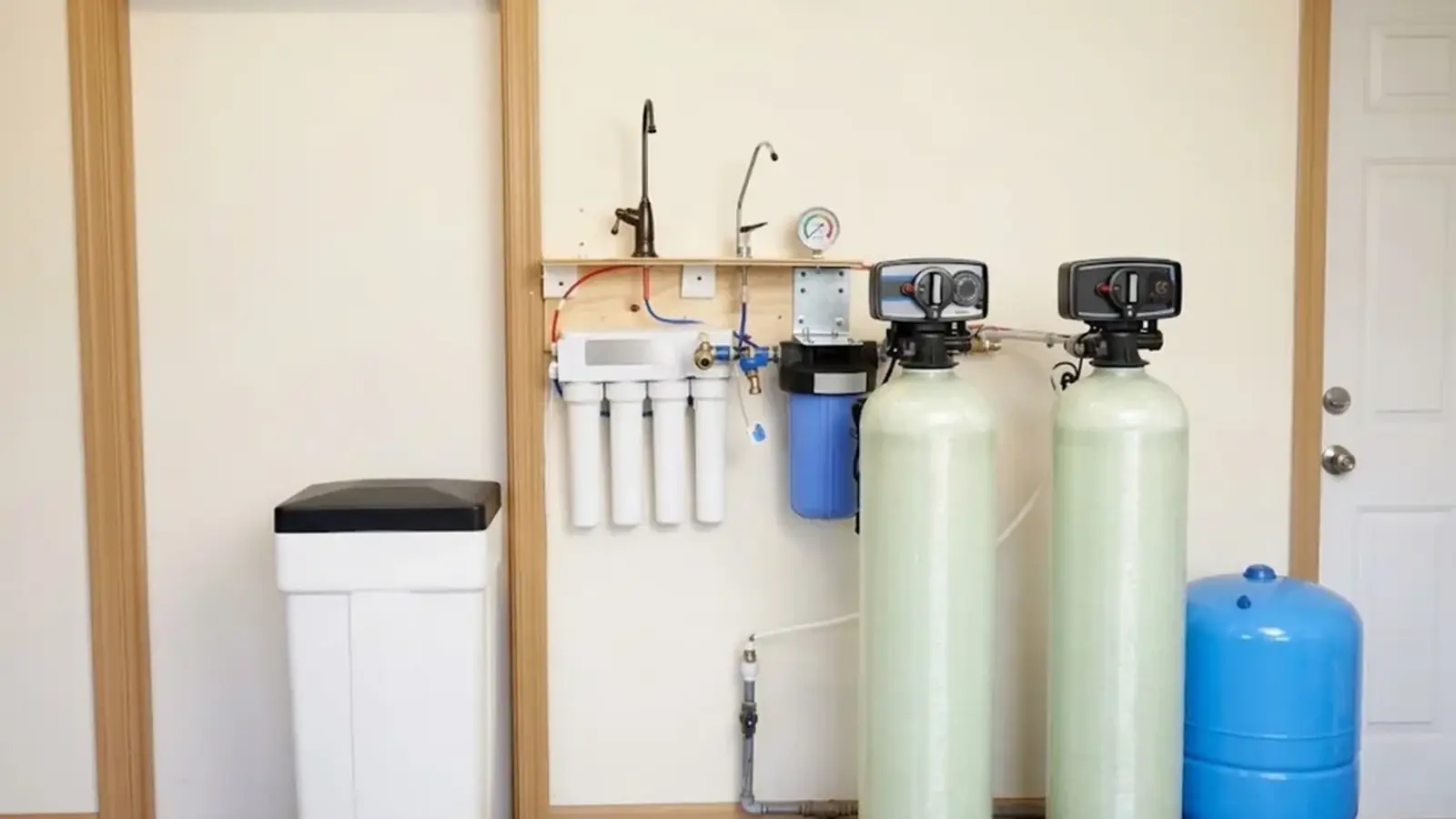
Why softeners drain at all
A salt-based softener regenerates by flushing brine through the resin tank. That flush must go somewhere. The wastewater is salty and full of the minerals the resin removed, and it flows out of a drain line on the control valve.
The brine tank also has an overflow line. If the tank overfills, the overflow gets it out of the way. That line has its own rules, and it must never be connected in a way that lets sewage or drain water back in.
What an air gap is
An air gap is a vertical space where the drain hose ends above the receiving drain. Nothing connects the two. If the drain backs up, the water rises in the drain, hits the air and spills out of the standpipe instead of rising into the hose.
| Method | Air gap? | Notes |
|---|---|---|
| Hose hung over a laundry standpipe | Yes, if the hose end stays well above the standpipe rim | Do not push the hose down into the pipe. |
| Hose over a floor drain | Yes, if the hose end is held above the drain | Common in garages. |
| Hose over a utility sink | Yes, if the end sits above the sink's flood rim | Secure the hose so it cannot drop. |
| Air gap fitting on a standpipe | Yes, built into the fitting | Needs the correct fitting size. |
| Hose pushed deep into a standpipe | No | A backflow risk. |
The code in plain terms
The plumbing code sets a minimum gap and requires it for equipment that discharges waste. Exact distances depend on the pipe size and the fitting, and your softener's manual states what the manufacturer requires. Follow the manual and ask the city what applies to your job.
Where this gets tricky is a drain that is not nearby. Running a hose across a garage floor or into a wall invites kinks and leaks. In those cases a plumber can add a standpipe or a dedicated drain with an air gap fitting.
Common mistakes
Mistakes that defeat the air gap
- Pushing the hose down into the standpipe and sealing it with tape.
- Letting the hose end drop below the rim.
- Kinking the hose on its way to the drain.
- Connecting the overflow line to the same hose.
- Running the drain uphill farther than the manufacturer allows.
- Forgetting that a floor drain can back up in heavy rain.
Test the setup after the install. Run a regeneration cycle and watch the drain. The flow should be steady and the hose end should stay clear. If the drain is slow, fix it before the softener runs a full cycle at night.
Why a slow drain matters
A softener that discharges into a slow drain can overflow the standpipe or the sink. If the gap is correct, the overflow spills visibly instead of siphoning back, which is the point of the gap, but it still means a wet floor. A clogged line should be cleared. Our drain cleaning work handles that.
A simple air gap check you can do
Look at the end of the drain hose. Is it clearly above the rim of the standpipe, sink or drain it empties into? Is the hose held in place so it cannot slip down? Is the hose free of kinks along its whole length? Three yes answers mean you probably have a working air gap.
Then run a regeneration cycle and watch. The water should leave the hose in a steady stream and disappear down the drain without rising. If the drain fills or the water splashes out, the drain is too slow for the flow, and it needs attention.
Finally, check the brine tank overflow. It should route to a safe place, and it should not share a line with the main drain hose. If you are unsure, a plumber can sort out both in a short visit.
What this means for Lynwood homes
Liberty Utilities' Lynwood system report lists hardness from 99 to 220 ppm, averaging 160 ppm. South Gate's city report averaged 226 mg/L in 2021. In water that hard, a softener regenerates often, so its drain sees regular use and any weakness in the gap shows up quickly.
Census estimates put about 47 percent of Lynwood housing before 1950. Laundry standpipes and garage drains in those homes may be old cast iron with rough walls, so confirm that the drain you plan to use runs freely before you connect the softener.
The City of Lynwood adopts the California Plumbing Code in Chapter 11-9. Ask its community development department what your softener's drain connection needs.
Air gap rules come from the California Plumbing Code, which is based on the Uniform Plumbing Code (UPC).
Call and describe where the hose ends. We will check the gap and the drain.
Homes in the 90280 ZIP code are covered through our South Gate page.
Questions homeowners ask about this
A physical space between the drain hose and the drain, so wastewater cannot flow back into the softener.
Not deeply or sealed. That removes the air gap. Keep the hose end above the rim.
It must discharge safely and never connect in a way that lets drain water back in. Follow the manual and local rules.
Usually not. A cleanout is not a drain for equipment, and a plumber can advise on a proper connection.
A plumber can add a standpipe or a dedicated drain with an air gap fitting.
With about 47 percent of homes built before 1950, older cast iron drains can run slow, and a slow drain makes the softener overflow.